
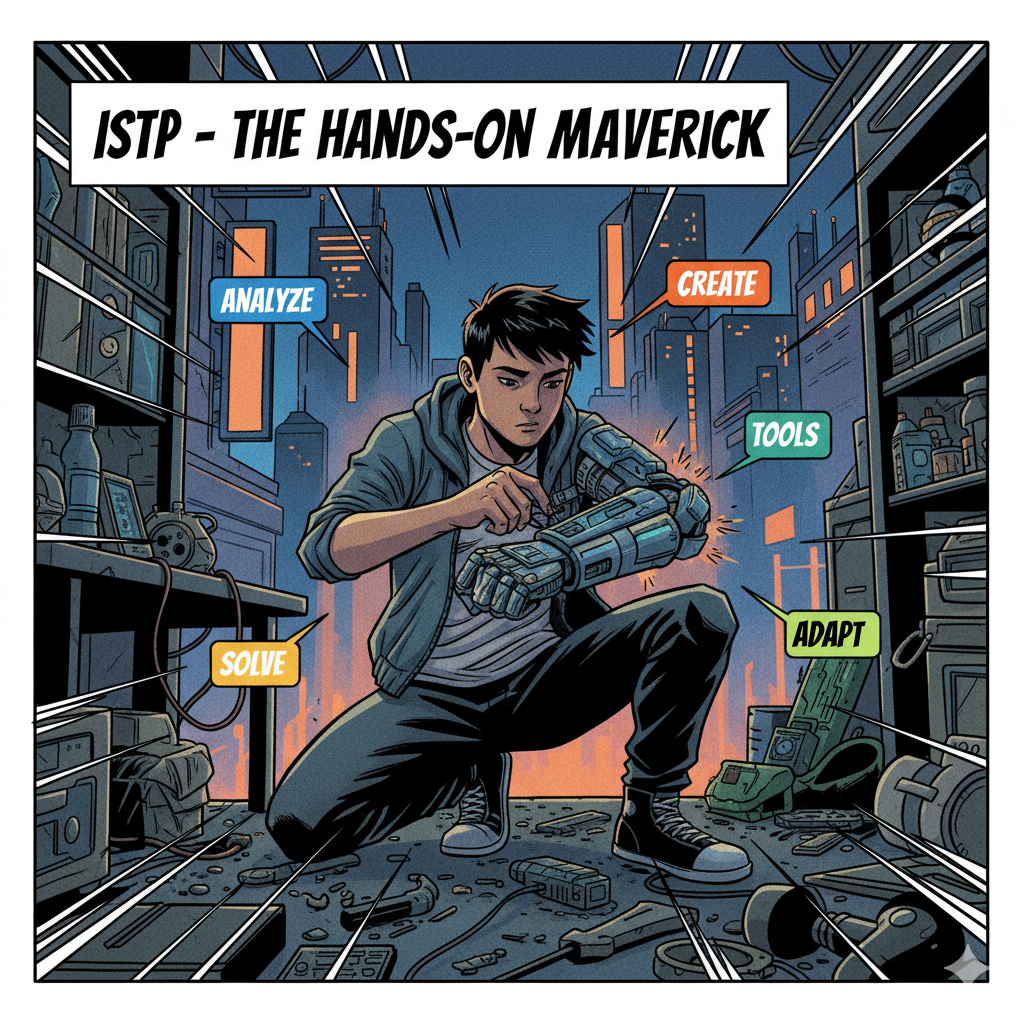
ISTP – The Hands-On Maverick
An ISTP is one of the sixteen Myers-Briggs personality types, described by the preferences Introverted, Sensing, Thinking and Perceiving. ISTPs work things out by taking them apart, stay calm in situations that panic other people, and resist being scheduled. In short: ISTPs work out how a thing behaves by handling it, and trust what they have tested over what they have been told. Elsewhere you may see this type called the Crafter or the Virtuoso.
One framing note before the description. This type gets written up as detached or hard to read, which mistakes economy of speech for absence of interest. What follows describes the preference for acting over narrating, and where that preference actually costs something.
What the four letters mean for an ISTP
- Introverted (I): ISTPs are self-contained. They are often easy company and still need considerable time alone, and they rarely explain their reasoning unless asked.
- Sensing (S): Attention goes to what is physically present and immediately actionable — the machine, the terrain, the tool, the actual behaviour of the thing in front of them.
- Thinking (T): Decisions run on whether something works and whether the logic holds. Sentiment is not a persuasive argument.
- Perceiving (P): They keep options open. A plan feels like a constraint on responding well to what actually happens.
How ISTPs think
The ordered habits for an ISTP run: introverted Thinking, extraverted Sensing, introverted Intuition, extraverted Feeling.
Introverted Thinking leads. It is a private, precise sorting mechanism: does this hold together, where exactly does it fail, what is the minimum explanation that accounts for it. ISTPs are frequently unable to explain conclusions they are entirely sure of, because the reasoning ran without narration.
Extraverted Sensing supports it, keeping them tightly coupled to the physical present. This is the combination behind the type's competence in real time — an ISTP diagnosing a fault is running analysis and direct observation together, adjusting continuously as the situation reveals itself.
Introverted Intuition sits underneath, occasionally producing a strong sense of where something is going. Extraverted Feeling — the tracking of group emotional state — is least developed, which is why ISTPs can be genuinely surprised that something they said landed badly.
Strengths of the ISTP
- Real-time problem solving. In an unfolding situation with incomplete information, ISTPs are among the most useful people present.
- Mechanical and spatial intuition. Systems that can be touched are understood quickly and often without instruction.
- Unusual composure. Crisis narrows most people; it tends to clarify ISTPs.
- Economy. They will find the shortest path that actually works and discard the ceremony around it.
- Independence. ISTPs do not need approval to proceed, which makes them hard to pressure and easy to underestimate.
Where ISTPs get stuck
- Commitment ahead of time. Agreeing now to something months out feels like signing away optionality, so ISTPs under-commit and can seem unreliable to planners.
- Explaining reasoning. The conclusion is available; the derivation often is not. Colleagues can experience this as stubbornness.
- Boredom as a decision-maker. Once a problem is solved, interest can drop sharply — including in problems they are contractually responsible for.
- Emotional expression. Feelings tend to be handled privately, and partners can be left guessing.
- Conflict handled by leaving. Physically or conversationally exiting is the default, and it postpones rather than resolves.
ISTPs at work
ISTPs do best where the feedback loop is short and the work is real: engineering and maintenance, trades and construction, emergency services, aviation, surgery and paramedicine, security and forensics, mechanics, industrial and field operations, and hands-on software or hardware work.
What tends to help an ISTP perform:
- Concrete problems with observable outcomes.
- Autonomy over method and pace.
- Minimal meetings and minimal process theatre.
- Competence recognised through responsibility rather than through praise.
What tends to drain them: long planning cycles, mandatory enthusiasm, rigid schedules, and being asked to document what they already fixed.
The recurring career risk is plateauing by choice — ISTPs often decline the promotions that would increase their influence because those roles are made of meetings, and then find themselves managed by people with less technical judgement.
ISTPs in relationships
ISTPs show care by doing: fixing, driving, showing up when something has gone wrong, solving the concrete problem. They are typically low-drama partners who do not manufacture conflict and do not enjoy processing feelings at length.
The friction is usually about expression and about space. ISTPs need more independence than most partners expect and interpret requests for constant togetherness as pressure. They also default to silence when upset, which a partner may read as indifference when it is closer to the opposite.
The single most useful adjustment is verbalising slightly more than feels necessary — not a monologue, just enough that the other person is not inferring from behaviour alone.
ISTPs under stress
Under moderate stress ISTPs disengage: withdrawing, going quiet, and handling it alone. Pressure to talk about it accelerates the withdrawal.
Under severe stress the neglected social-emotional side breaks through, and a normally unflappable person becomes uncharacteristically emotional — hypersensitive to whether they are valued, occasionally with an outburst that surprises everyone including them.
Recovery is physical and solitary: movement, a concrete task, time outdoors, space without demands. Being pursued in this state makes it worse.
Common misconceptions about ISTPs
- "ISTPs are lazy." They are highly selective. An uninterested ISTP looks inert; an engaged one will work through the night without being asked.
- "ISTPs are reckless." Many enjoy risk, but the competent ones have usually assessed it faster and more accurately than their critics.
- "ISTPs are not intellectual." The analysis is constant and unspoken. Plenty of ISTPs are deeply theoretical about the systems they care about.
- "ISTPs do not care." Attachment is real and simply not narrated.
How ISTP differs from similar types
- ISTP vs ISTJ: Same practicality, opposite relationship to structure. The ISTJ plans, schedules and honours precedent; the ISTP improvises and keeps options open. Both are competent; only one wants the calendar.
- ISTP vs INTP: Both lead with private logical analysis. The ISTP applies it to physical, immediate systems; the INTP to abstract, theoretical ones. The ISTP fixes the engine, the INTP questions the concept of the engine.
- ISTP vs ESTP: Nearly the same toolkit at different volumes. ESTPs engage the room, take social risks and act outwardly; ISTPs observe, act efficiently and prefer not to be watched.
- ISTP vs ISFP: Both are present-focused and resistant to structure. The ISFP decides by personal values and cares about the human effect; the ISTP decides by logic and cares whether it works.
How this result was arrived at
Four letters are only as informative as the instrument that produced them, so here is ours.
The test asks eight questions, two for each dimension, and scores them positionally. I/E, S/N, T/F and J/P are settled independently, and nothing in the scoring nudges a borderline answer toward a type that reads as more interesting.
For ISTP the letter most often decided narrowly is the S. Fluency with how systems behave can come from direct hands-on experience or from a model built in the abstract, and two questions do not always separate the two. If your S felt close, the INTP description is the one to read beside this.
An ISTP result here means eight questions pointed that way. That is a hypothesis to test against your own experience, not a boundary.
Is this actually you?
Treat this as a description of defaults rather than a verdict, and the parts that do not fit as information rather than error — a description fitting someone completely would be describing the person, not the type.
If it feels close but not exact, answering the questions yourself is a faster check than reasoning about the description, and the result costs nothing to discard.