
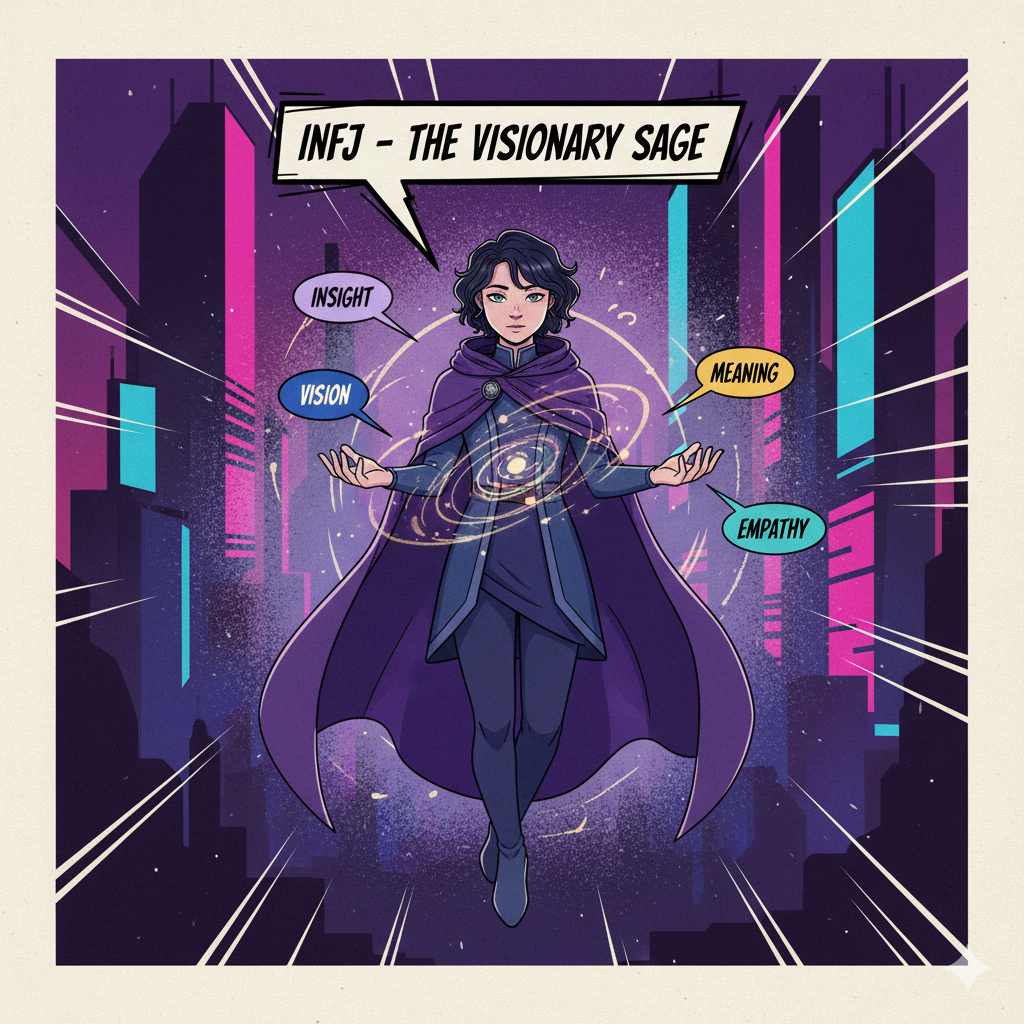
INFJ – The Visionary Sage
An INFJ is one of the sixteen Myers-Briggs personality types, described by the preferences Introverted, Intuitive, Feeling and Judging. In short: INFJs read where a situation is heading before the evidence is in, attend closely to individual people, and need their work to mean something. Elsewhere you may see this type called the Counselor or the Advocate.
Two things are worth saying before the description, because they change how it should be read. Type is a description of tendencies, not a diagnosis or a limit. And INFJ in particular attracts more romanticised writing than any other type — much of what circulates about it is flattery rather than observation, which is why the sections below include the failure modes as plainly as the strengths.
What the four letters mean for an INFJ
- Introverted (I): INFJs need substantial solitude to function, even when they enjoy people. Social contact is often rewarding and expensive at the same time.
- Intuitive (N): Attention goes to pattern, implication and where a situation is heading rather than to its present surface detail.
- Feeling (F): Decisions run through values and human impact. An INFJ can build a coldly logical case and will still refuse a conclusion that violates something they believe.
- Judging (J): They want closure and direction. Ambiguity about the destination is more stressful for an INFJ than a difficult but defined path.
How INFJs think
The ordered habits for an INFJ run: introverted Intuition, extraverted Feeling, introverted Thinking, extraverted Sensing.
Introverted Intuition leads, and it works by convergence rather than brainstorming. An INFJ absorbs a large amount of input, goes quiet, and returns with a single conclusion that feels certain but whose derivation they often cannot reconstruct. This is the origin of the type's reputation for insight — and of its characteristic failure mode, which is confidence in a conclusion that has not actually been checked.
Extraverted Feeling supports it, giving INFJs a continuous read on other people's states and a strong pull toward harmony. Introverted Thinking underneath supplies the drive to make ideas internally consistent. Extraverted Sensing — direct engagement with immediate physical reality — is least developed, which is why INFJs can neglect the body, the room and the present moment while attending to the pattern.
Strengths of the INFJ
- Pattern recognition across people and time. INFJs frequently see where a relationship or an organisation is heading well before the evidence is conclusive.
- Depth of individual attention. In one-to-one conversation they are genuinely good at making another person feel understood, because they largely are understanding them.
- Conviction that survives inconvenience. When an INFJ decides something matters, effort follows for years without external reward.
- Synthesis. They connect ideas from unrelated domains and produce a coherent account, which makes many INFJs strong writers, teachers, counsellors and designers.
- Principled independence. Social pressure moves them far less than it appears to, because the pull toward harmony is real but the values underneath are stronger.
Where INFJs get stuck
- Insight without verification. The conclusion arrives whole and convincing. Convincing is not the same as correct, and INFJs check less often than they should.
- Absorbing other people's states. Continuous emotional attunement is exhausting and blurs the line between what the INFJ feels and what they have picked up.
- Perfectionism that prevents shipping. An unrealised ideal version of the work can make the achievable version feel not worth releasing.
- Withdrawal instead of confrontation. Rather than have the difficult conversation, an INFJ may quietly downgrade the relationship — sometimes permanently, and often without the other person understanding what happened.
- Neglect of the concrete. Sleep, food, money and maintenance get deprioritised in favour of meaning, until they force attention.
INFJs at work
INFJs need to believe the work matters; without that, competence does not translate into motivation. They tend to do well in counselling and therapy-adjacent roles, teaching, writing and editing, design and user research, human resources, non-profit and mission-led organisations, and any role where understanding people accurately is the core of the job.
What tends to help an INFJ perform:
- A stated purpose they actually believe.
- Deep, uninterrupted time rather than fragmented availability.
- One-to-one working relationships over large-group dynamics.
- Autonomy over how the work is done.
What tends to drain them: open-plan noise, constant availability, adversarial environments, and being asked to advocate for something they consider hollow.
INFJs also tend to be over-consulted informally. Because they listen well, colleagues bring them problems that are not their responsibility, and the resulting load is invisible on any org chart.
INFJs in relationships
INFJs invest deeply and selectively. They typically maintain a small number of close relationships and treat them as central to their life rather than as one component among many. They are attentive partners who often anticipate needs accurately.
Two patterns cause most of the difficulty. The first is idealisation: forming a vivid picture of who someone could be and then being disappointed by who they are. The second is the sudden withdrawal sometimes called the INFJ door slam — an accumulation of unspoken grievances resolved unilaterally by ending contact. Both are considerably reduced by the same discipline: saying the difficult thing early, in ordinary language, before it becomes structural.
INFJs also need more solitude than they usually feel entitled to ask for. Framing it as a requirement rather than a rejection prevents a great deal of unnecessary hurt.
INFJs under stress
Under moderate stress INFJs become withdrawn, over-analytical and certain — closing down alternatives and treating an interpretation as established fact.
Under severe stress the neglected sensory side takes over, and a normally future-focused, abstract person becomes fixated on immediate physical particulars: overeating, compulsive tidying, exercise binges, obsessive attention to a bodily symptom or a small detail of the environment. It is unmistakable to anyone who knows them.
Recovery comes from reducing input, restoring sleep, spending time in nature or in movement, and talking to one trusted person rather than reasoning alone in a closed loop.
Common misconceptions about INFJs
- "INFJs are psychic." They read behavioural and contextual cues rapidly and often unconsciously. It is inference, it is fallible, and treating it as certainty is the type's main analytical error.
- "INFJs are fragile." Sensitivity to atmosphere is not the same as weakness. INFJs sustain unpopular positions for long periods.
- "INFJs are rare and therefore special." Frequency estimates for this type are low, but rarity carries no merit and the framework was never designed to rank types.
- "INFJs are always gentle." The pull toward harmony is real, but INFJs can be blunt and immovable once a value is at stake.
How INFJ differs from similar types
- INFJ vs INFP: Both are idealistic, private and values-driven, and they are the pair most often confused. INFPs explore possibilities outward and hold values inward, which makes them more open-ended, more improvisational and slower to close a question. INFJs converge inward and express values outward, which makes them more decisive, more organised and more concerned with group harmony.
- INFJ vs ISFJ: Both are conscientious and caring. The ISFJ works from concrete detail and present need; the INFJ from pattern and future implication. ISFJs are more practically dependable, INFJs more symbolically oriented.
- INFJ vs INTJ: Similar convergent insight, different decision criteria. INTJs test conclusions against internal logic and are comfortable being disliked; INFJs test them against human impact and find disapproval costly.
- INFJ vs ENFJ: The same values, differently sourced. ENFJs draw energy from leading and engaging groups; INFJs need to withdraw to think and prefer influence at close range.
How this result was arrived at
Most descriptions of this type are written from the framework alone. This one comes with the instrument attached, so it is worth being explicit about how a result gets produced here and what it can and cannot support.
Our test asks eight questions, two per dimension, and scores them positionally — the four preferences are decided independently of each other. There is no weighting that pushes an ambiguous answer toward a "more interesting" type, and no result is more desirable than another in the scoring.
That design has a consequence we would rather state than hide: with two questions per dimension, a split answer leaves that preference genuinely undetermined rather than marginal, and that happens often.
So if you came out INFJ here, the honest reading is that eight questions pointed that way — not that a boundary has been established. Where a preference felt close while answering, it probably is close, and the neighbouring type's description is worth reading as well. That is what the comparisons above are for.
Is this actually you?
Read this as a description of tendencies, not as an identity to defend. The parts that do not fit are information rather than error — a description that matched a person completely would be describing the person, not a type.
If it feels close but not exact, answering the questions yourself is a faster check than reasoning about the description, and the result costs nothing to discard.