
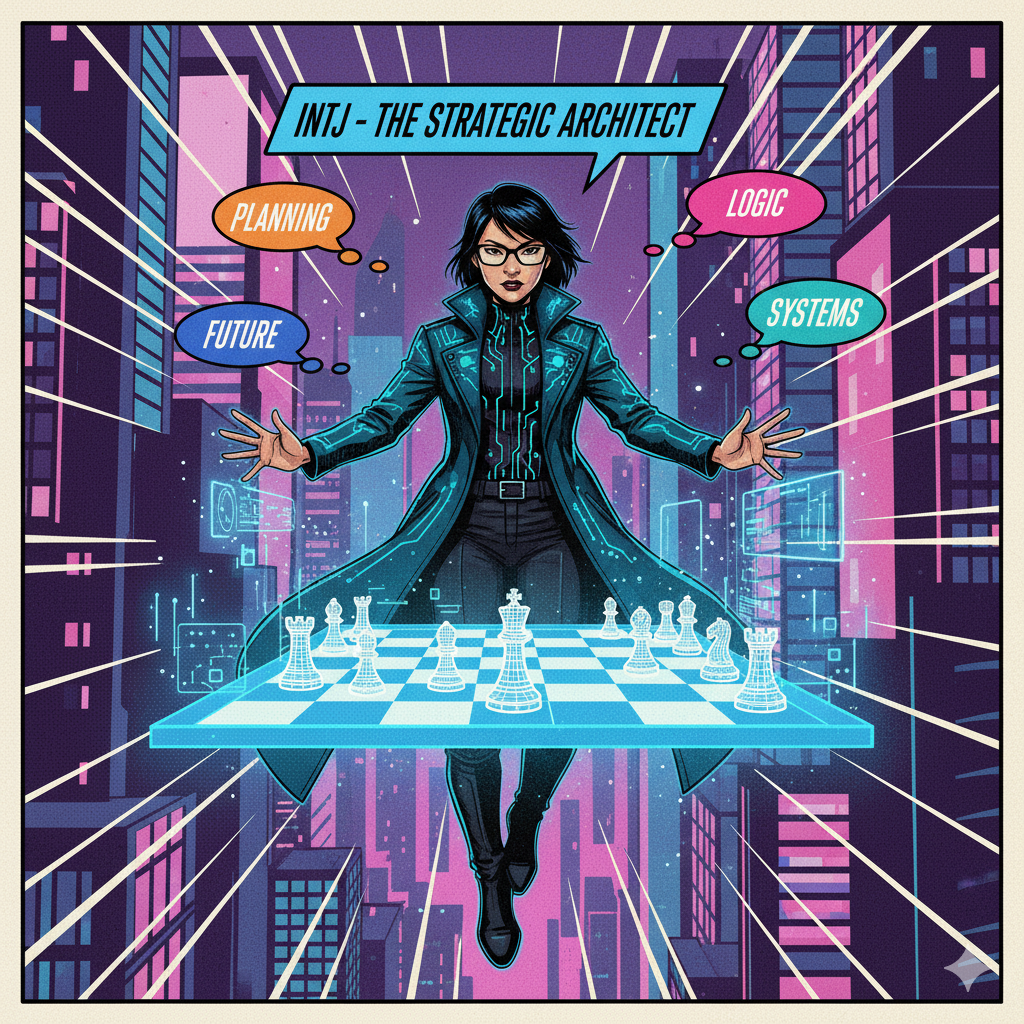
INTJ – The Strategic Architect
An INTJ is one of the sixteen Myers-Briggs personality types, described by the preferences Introverted, Intuitive, Thinking and Judging. INTJs build a model of how something works, decide what it should become, and then work backwards to the steps — with a strong preference for doing so independently. In short: INTJs build a model of how something works, then act on the model — and tend to be comfortable being the only one who agrees with it. Elsewhere you may see this type called the Mastermind or the Architect.
One framing note before the description. INTJ attracts more self-flattering writing than almost any type, most of it about rarity and intelligence. Neither is a claim this page will make: the framework was never designed to rank people, and rarity carries no merit.
What the four letters mean for an INTJ
- Introverted (I): INTJs think privately and arrive with conclusions rather than thinking out loud. Extended social exposure is tiring regardless of how much they like the people.
- Intuitive (N): They attend to structure, implication and trajectory. The specific present instance interests them mainly as evidence about the system that produced it.
- Thinking (T): Decisions are judged by whether the reasoning holds. An INTJ can accept an unwelcome conclusion relatively easily if the argument is sound.
- Judging (J): They want the question closed and the plan running. Indefinite deliberation is intolerable.
How INTJs think
The ordered habits for an INTJ run: introverted Intuition, extraverted Thinking, introverted Feeling, extraverted Sensing.
Introverted Intuition leads and works by convergence: absorb a large amount of information, let it settle, and produce a single model of what is really going on. INTJs are typically more confident in that model than the evidence strictly warrants, and much of their practical effectiveness comes from how often the model turns out to be roughly right.
Extraverted Thinking supports it by organising the outside world to match — plans, systems, sequences, decisions. The pairing is what makes this type strategic rather than merely analytical: the model is not the endpoint, the implementation is.
Introverted Feeling sits underneath as a private and rarely-articulated set of values, which is why INTJs who appear purely clinical are often driven by something deeply personal. Extraverted Sensing is least developed, so immediate physical reality — the room, the body, the present moment — gets less attention than the plan.
Strengths of the INTJ
- Long-range structural thinking. INTJs are unusually good at seeing what a system will do several steps ahead, including the failure modes nobody has hit yet.
- Independence from consensus. Being in a minority is not distressing, which allows an INTJ to hold a correct unpopular position long enough for it to matter.
- Willingness to revise. Presented with a better argument, an INTJ will change their mind — sometimes abruptly. The model is loved, but the evidence outranks it.
- Self-directed competence. They will teach themselves whatever the plan requires, without supervision and often without mentioning it.
- Decisiveness once analysis is done. The deliberation is front-loaded; the execution is not hesitant.
Where INTJs get stuck
- Certainty ahead of verification. The convergent conclusion feels finished. When it is wrong, it is wrong confidently and sometimes expensively.
- Underweighting the human variable. Plans that are correct on the merits still fail if nobody was brought along, and INTJs consistently treat that as someone else's problem.
- Bluntness read as contempt. Efficient correction feels neutral from the inside and frequently does not land that way.
- Difficulty delegating. If the INTJ can do it to their own standard and explaining is slower than doing, they will absorb it — and then be overloaded.
- Neglect of the present. Health, maintenance and relationships get deferred behind the objective until they force attention.
INTJs at work
INTJs want leverage: problems where thinking harder measurably changes the outcome. They tend to do well in strategy, research, engineering and architecture, data and analytics, medicine and law, systems design, and founding or running something where they control the direction.
What tends to help an INTJ perform:
- Being given the objective and the constraints, then left alone on method.
- Access to whoever actually knows, without layers.
- Time to think before being asked to commit.
- Colleagues who argue with the reasoning rather than with the tone.
What tends to drain them: micromanagement, meetings that restate known information, decisions made on hierarchy rather than argument, and enforced enthusiasm.
The recurring INTJ career problem is being technically right and organisationally ineffective. Influence in most organisations is distributed through relationships that INTJs consider overhead, and declining to invest in them is a choice with predictable consequences.
INTJs in relationships
INTJs are selective and, once committed, notably steady. They are not casual about relationships; they are slow to enter them and then treat them as settled rather than as continuously renegotiated.
Their affection tends to be expressed through investment: attention to the other person's actual problems, willingness to reorganise plans around them, competence deployed on their behalf. What is usually missing is routine verbal reassurance, which INTJs consider redundant — the commitment was made and has not changed, so why restate it? Partners who need to hear it are not being needy, and this is one of the highest-return adjustments an INTJ can make.
The other common friction is problem-solving when comfort was wanted. INTJs offer solutions because offering solutions is respect. Asking which one is wanted takes three seconds and prevents a recurring argument.
INTJs under stress
Under moderate stress INTJs become more controlling and more dismissive: tightening the plan, cutting people out of it, and treating disagreement as noise.
Under severe stress the neglected sensory side breaks through and a normally abstract, disciplined person becomes uncharacteristically indulgent or fixated on physical particulars — overworking to exhaustion, overeating, drinking, compulsive exercise, or obsessing over a small concrete detail. INTJs often find this state more distressing than the original stressor, because it is so unlike their self-image.
Recovery is unglamorous: sleep, physical movement, reduced input, and one conversation with someone they trust enough to think out loud with.
Common misconceptions about INTJs
- "INTJs are unemotional." Feeling is private, not absent, and INTJs are frequently driven by convictions they never state.
- "INTJs think they are smarter than everyone." Many are confident in their reasoning specifically and quite insecure elsewhere. Confidence about an argument is not a global claim.
- "INTJs are natural leaders." They are natural strategists. Leadership requires bringing people along, which is the part this type most often skips.
- "INTJs are rare geniuses." The framework does not measure ability, and no type has a monopoly on competence.
How INTJ differs from similar types
- INTJ vs INTP: Both are private, analytical and unimpressed by authority. The INTP is oriented toward whether an idea is internally coherent and is content to leave it open; the INTJ is oriented toward whether it can be implemented and wants it closed. INTPs refine, INTJs deploy.
- INTJ vs INFJ: The same convergent insight with a different decision rule. INTJs check conclusions against logic and accept being disliked; INFJs check them against human impact and find disapproval genuinely costly.
- INTJ vs ENTJ: Nearly the same strategic drive, aimed inward and outward respectively. ENTJs think out loud, mobilise people and take the room; INTJs prefer to work the problem alone and present the finished conclusion.
- INTJ vs ISTJ: Both are private, decisive and unsentimental. The ISTJ trusts what has been proven to work and protects it; the INTJ trusts the model of what should work and rebuilds toward it.
How this result was arrived at
Before treating four letters as meaningful, it helps to know how they were produced.
Our test asks eight questions, two per dimension, and scores them positionally. Each of the four preferences is decided on its own, and nothing in the scoring pushes an ambiguous answer toward a type that sounds more interesting.
For INTJ, the letter most likely to be marginal is the I. Long stretches of independent thinking look introverted from outside regardless of where someone actually recovers their energy, and two questions are a coarse instrument for that. If the I felt close while answering, read the ENTJ description alongside this one.
An INTJ result here means eight questions pointed that way — a hypothesis worth testing against your own experience, not a conclusion.
Is this actually you?
Treat this as a hypothesis about your defaults rather than a verdict. The parts that do not fit are information — a description matching someone completely would be describing that person, not a type.
If it feels close but not exact, answering the questions yourself is a faster check than reasoning about the description, and the result costs nothing to discard.