
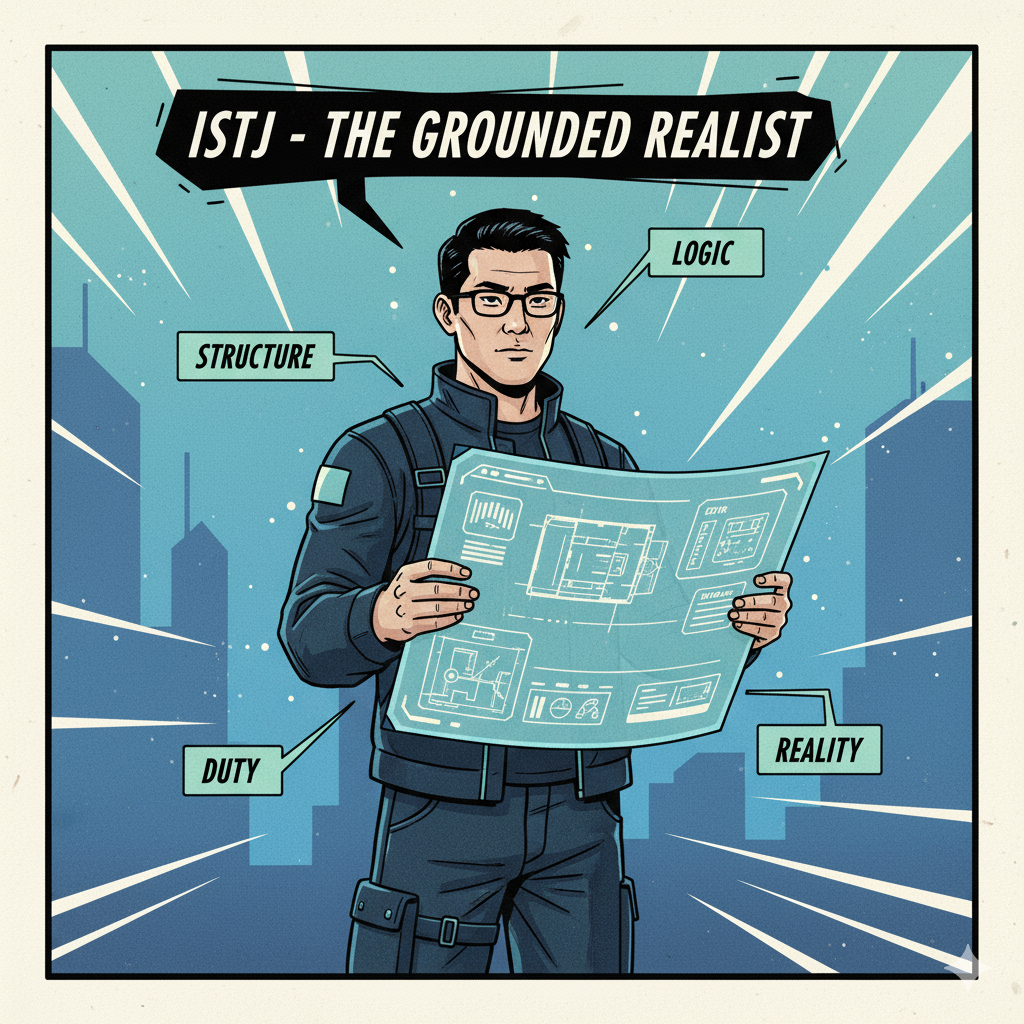
ISTJ – The Grounded Realist
An ISTJ is one of the sixteen Myers-Briggs personality types, described by the preferences Introverted, Sensing, Thinking and Judging. ISTJs are the people who remember what was actually agreed, who finish what they start, and who would rather be reliable than impressive. In short: ISTJs remember what was actually agreed, finish what they start, and would rather be reliable than impressive. Elsewhere you may see this type called the Inspector or the Logistician.
One framing note before the description. ISTJ is among the most common types in our own data, and common types tend to get written about dismissively — as though dependability were the absence of imagination. The sections below treat it as a competence with costs, which is what it is.
What the four letters mean for an ISTJ
Every type shares the same four dimensions, but they combine differently in each one. For an ISTJ they play out like this.
- Introverted (I): ISTJs process by thinking first and speaking second. They are not necessarily shy — many are perfectly comfortable running a meeting — but they lose energy in long unstructured social stretches and regain it alone with a task.
- Sensing (S): They trust what can be observed, measured and verified. A concrete precedent carries more weight than an elegant theory, and "we tried this in March and it failed" is, to an ISTJ, a complete argument.
- Thinking (T): Decisions get made on consistency and fairness rather than on how each person will feel about them. This is not coldness; it is the belief that the same rule should apply to everyone.
- Judging (J): They want things settled. Open loops are genuinely uncomfortable, and an ISTJ will often close a decision early simply to stop carrying it around.
How ISTJs think
The Myers-Briggs framework describes each type as an ordered set of mental habits. For ISTJs the order runs: introverted Sensing, extraverted Thinking, introverted Feeling, extraverted Intuition.
Introverted Sensing leads. It works like a richly indexed archive of personal experience. An ISTJ meeting a new situation instinctively asks what does this resemble that I have already seen? — which is why they spot the detail that is subtly wrong long before they can explain why it bothers them.
Extraverted Thinking supports it. Once the archive returns an answer, the ISTJ wants to organise the world to match: sequence the steps, assign the owners, set the date. The combination produces someone who is both careful and decisive, an unusual pairing.
Introverted Feeling sits underneath, quiet and rarely spoken aloud. ISTJs have strong private convictions about right and wrong, and are far more emotionally invested in their commitments than they let on. Extraverted Intuition — the habit of generating alternative possibilities — is the least developed, which is why unfamiliar and open-ended situations cost an ISTJ more effort than they cost almost anyone else.
Strengths of the ISTJ
- Follow-through that does not depend on mood. An ISTJ who says yes on Monday will still be doing it in November. The commitment is not renegotiated every time enthusiasm dips.
- Accuracy under volume. They will find the one transposed figure in a long report, because inconsistency registers as almost physically uncomfortable.
- Institutional memory. ISTJs remember the reasoning behind decisions, not just the decisions, which makes them the person a team turns to when nobody can recall why a rule exists.
- Calm in a genuine crisis. When a situation resembles something previously handled, ISTJs become noticeably steadier while others become louder.
- Fairness applied consistently. They apply the same standard to themselves that they apply to everyone else, which over time earns a specific kind of trust.
Where ISTJs get stuck
- Precedent used as proof. "That is not how we do it" is a description of the past, not an argument about the future. ISTJs sometimes treat the two as the same thing.
- Late-arriving change. Because change is evaluated against experience, and a genuinely new thing has no precedent to match, ISTJs can reject a good idea early and only recognise its value once someone else has proven it.
- Silent overload. Stress is absorbed rather than reported. By the time an ISTJ mentions that the workload is unreasonable, it has usually been unreasonable for months.
- Warmth that stays unspoken. Loyalty gets expressed through reliability — showing up, fixing things, remembering. People who need to hear it can miss it entirely.
- Standards applied outward. Holding others to an ISTJ's own tolerance for detail is rarely realistic, and reads as criticism even when it is not meant that way.
ISTJs at work
ISTJs are drawn to environments where the standard is knowable and performance is measurable. They do well where accuracy compounds — operations, finance, compliance, quality assurance, logistics, engineering, law, systems administration — and less well where the goal moves weekly and nobody can say what "done" means.
What tends to help an ISTJ perform:
- Written expectations rather than implied ones.
- Enough lead time to check the work before it is seen.
- Autonomy over method once the target is agreed.
- A reason attached to each change, not just the change.
What tends to drain them: constant reprioritisation, meetings without an agenda, being asked to improvise in public, and having their carefulness described as slowness.
A frequent career trap is promotion by reliability. ISTJs get more work because they can be trusted with it, absorb it without complaint, and end up carrying an invisible load nobody has quantified. Making that load visible is a skill worth deliberately practising.
ISTJs in relationships
ISTJs commit slowly and then thoroughly. Their affection tends to be practical: the car gets serviced, the paperwork gets filed, the difficult phone call gets made. Ask an ISTJ to describe their feelings on demand and you will usually get a pause; watch what they arrange and maintain and the answer is unambiguous.
The friction in ISTJ relationships is rarely about commitment and usually about expression. Partners who need verbal reassurance can experience an ISTJ's steadiness as distance, while the ISTJ experiences the request for reassurance as doubting something already settled. It helps enormously when both sides name this directly rather than testing each other.
ISTJs also dislike having plans changed at short notice — not because the new plan is worse, but because the old one had already been mentally paid for. A little notice costs almost nothing and prevents a disproportionate amount of irritation.
ISTJs under stress
Sustained stress pushes an ISTJ into a narrower and more rigid version of themselves: more checking, more insistence on procedure, less patience for exceptions. If it continues, the usually-suppressed possibility-generating side breaks through unhelpfully, and a normally level person starts catastrophising — imagining elaborate negative futures that are quite unlike their ordinary realism.
The recovery pattern is reliably physical and concrete: sleep, exercise, a finite task completed properly, time alone. Being talked at about the bigger picture in this state makes it worse rather than better.
Common misconceptions about ISTJs
- "ISTJs are inflexible." They are slow to accept change without a reason, which is different. Give an ISTJ the reasoning and a little time and they will often implement the change more thoroughly than its author.
- "ISTJs have no imagination." They apply it to what is real and buildable rather than to what is hypothetical. Plenty of demanding, detailed craft work is done by ISTJs.
- "ISTJs are unemotional." Feeling runs privately and strongly. It is the disclosure that is restrained, not the experience.
- "ISTJs just follow rules." ISTJs follow rules they consider legitimate. Confront one with a rule they judge unfair and you will meet a surprisingly immovable objector.
How ISTJ differs from similar types
- ISTJ vs ISFJ: Both rely heavily on remembered experience and both are dependable. The ISFJ organises around people and reads the emotional temperature of a room continuously; the ISTJ organises around systems and standards. Asked to deliver bad news, an ISFJ worries about the impact, an ISTJ about the accuracy.
- ISTJ vs ESTJ: Nearly the same operating logic, aimed in opposite directions. ESTJs think out loud, take charge of the room and drive external structure. ISTJs prefer to reach a conclusion privately and then act. ESTJs will usually be visible sooner; ISTJs will usually have checked more.
- ISTJ vs INTJ: Both are private, decisive and unsentimental about facts. The INTJ starts from a model of how things could work and edits reality toward it; the ISTJ starts from how things have actually worked and protects what already functions. They frequently frustrate one another and complement one another well.
- ISTJ vs ISTP: Same first two letters, very different tempo. ISTPs improvise on the spot and resist being scheduled; ISTJs plan ahead and dislike improvising. Both are practical; only one wants a calendar.
How this result was arrived at
It is worth knowing how a four-letter result gets produced here, because that determines how much weight it can carry.
Our test asks eight questions, two for each of the four dimensions, and scores them positionally — I/E, S/N, T/F and J/P are decided independently, with no weighting that nudges an ambiguous answer toward a more flattering type.
For ISTJ specifically, the letter most often decided by the narrowest margin is the T. Someone who works from precedent and finishes what they promised can arrive at that behaviour through fairness-as-consistency or through fairness-as-care, and two questions do not always separate those. If your T felt close while answering, the ISFJ description is worth reading beside this one.
So an ISTJ result here means eight questions pointed that way. It is a starting hypothesis, not a boundary that has been established.
Is this actually you?
Read this as a hypothesis about how you tend to operate, not a verdict about who you are. The parts that do not fit are information rather than error — a description that fitted someone completely would be describing the person, not the type.
If it feels close but not exact, answering the questions yourself is a faster check than reasoning about the description, and the result costs nothing to discard.