
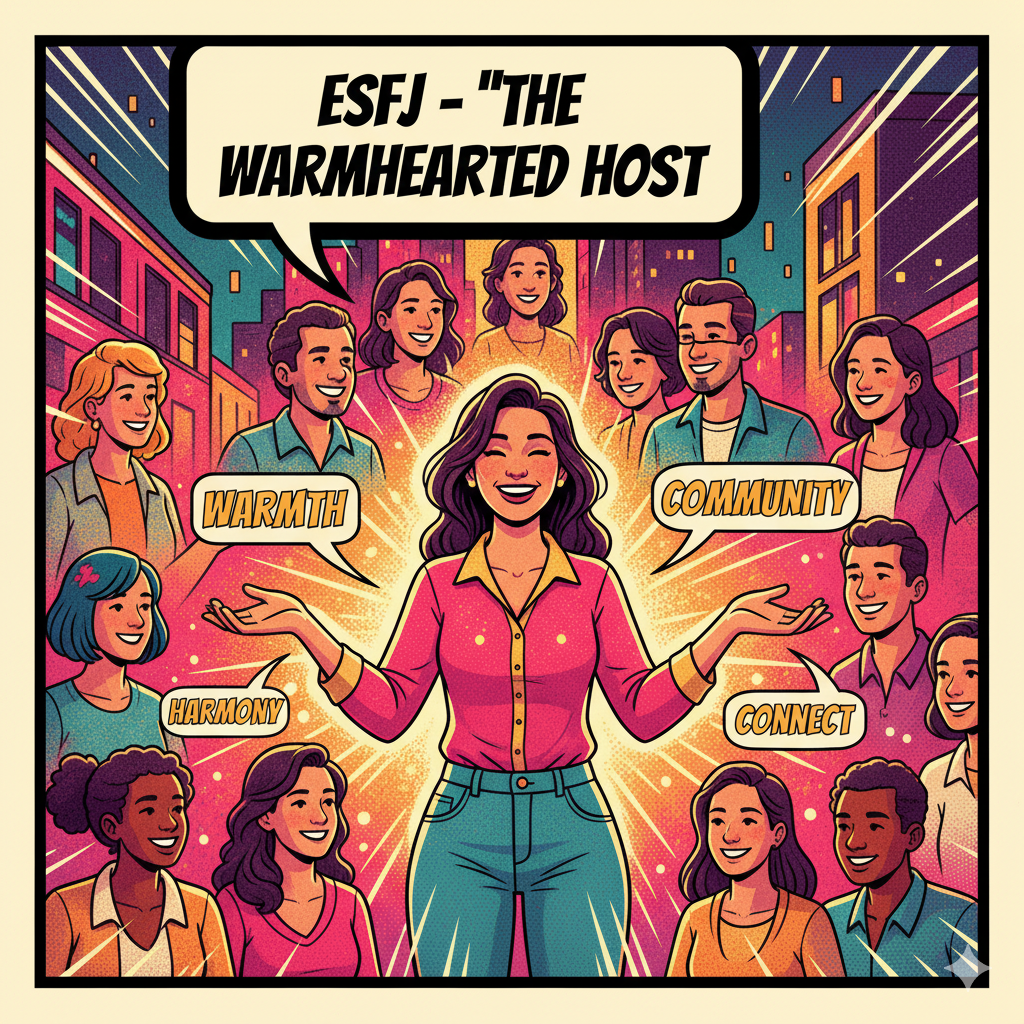
ESFJ – The Warmhearted Host
An ESFJ is one of the sixteen Myers-Briggs personality types, described by the preferences Extraverted, Sensing, Feeling and Judging. ESFJs organise the practical and emotional life of the groups they belong to, remember what matters to individuals, and are usually the reason things are actually arranged. In short: the ESFJ default is to absorb responsibility for how a group is doing, which is why so much of the work is invisible and why the resentment, when it finally arrives, surprises everyone including the ESFJ. Elsewhere you may see this type called the Provider or the Consul.
One framing note before the description. Writing about this type tends to praise the warmth and skip the arithmetic — that carrying a group has a cost, and that the cost is usually paid by the person least likely to mention it. Both halves are below.
What the four letters mean for an ESFJ
- Extraverted (E): ESFJs are energised by people and by being involved. They process out loud and dislike prolonged isolation.
- Sensing (S): Attention is on concrete particulars — who is coming, what is needed, what was promised, who seems off today.
- Feeling (F): Decisions are weighed by their effect on people. Harmony is treated as a real objective, not a nicety.
- Judging (J): They want commitments settled and honoured. Loose arrangements are uncomfortable.
How ESFJs think
The ordered habits for an ESFJ run: extraverted Feeling, introverted Sensing, extraverted Intuition, introverted Thinking.
Extraverted Feeling leads and is directed outward: reading the emotional state of the group, adjusting to it, and actively working to keep it good. ESFJs often know a team is in trouble weeks before it appears in any metric.
Introverted Sensing supports it with detailed memory for people and precedent — birthdays, preferences, the thing that upset someone last year, how this was handled before. Together these produce the type's characteristic competence: organised, personalised care delivered reliably.
Extraverted Intuition supplies some openness to alternatives. Introverted Thinking is least developed, which is why ESFJs can find impersonal analysis draining and can take a purely logical objection as a personal one.
Strengths of the ESFJ
- Practical care at scale. ESFJs organise the meals, the rotas, the visits and the follow-ups that hold communities together.
- Social accuracy. They notice who is struggling and act on it, usually before anyone has said anything.
- Reliability. Commitments are kept, and the follow-up actually happens.
- Warmth that includes people. ESFJs are unusually good at making a newcomer feel like they belong.
- Institutional glue. In most organisations, the person who knows everyone and keeps things connected is doing real and largely uncounted work.
Where ESFJs get stuck
- Over-commitment. Saying yes is easy and saying no feels like failing someone, so the load grows past what is sustainable.
- Sensitivity to criticism. Because the work is personal, feedback on it lands personally.
- Approval as a compass. Decisions can drift toward what will be well received rather than what is right.
- Conflict smoothed rather than resolved. Harmony restored quickly can leave the underlying problem intact.
- Unspoken expectations. ESFJs often give in the hope of reciprocity without stating the need, then feel unappreciated.
ESFJs at work
ESFJs do best in people-facing roles with clear structure. Common fits: healthcare and nursing, teaching, human resources, office and practice management, event planning, hospitality, customer success, community and social work, and administrative leadership.
What tends to help an ESFJ perform:
- Clear expectations and stable priorities.
- Visible appreciation, given specifically.
- Colleagues who communicate rather than go quiet.
- Permission to decline additional work without it being read as a problem.
What tends to drain them: hostile or political environments, isolated analytical work, chronic ambiguity, and being publicly criticised.
The recurring career risk is invisible labour. ESFJs frequently hold a team together emotionally and administratively while being formally responsible for neither, and that work rarely appears in a performance review unless they name it.
ESFJs in relationships
ESFJs are devoted, attentive partners who invest heavily in the practical and emotional maintenance of a relationship. They remember what matters, arrange what needs arranging, and take the commitment seriously.
Two patterns cause most difficulty. The first is unstated reciprocity: giving generously while hoping the other person will notice and match it, then feeling hurt when they do not. The second is conflict avoidance — smoothing over problems to restore harmony, which postpones rather than resolves.
Relationships work better when ESFJs state needs plainly and early. Partners consistently report that they would have happily met a need they were never told about.
ESFJs under stress
Under moderate stress ESFJs do more: organising harder, caring harder, managing everyone else's comfort while ignoring their own condition. Fatigue then shows as uncharacteristic irritability and a sense of being taken for granted.
Under severe stress the least-developed analytical side takes over, and a normally warm person becomes uncharacteristically cold and critical — issuing harsh judgements, withdrawing from people, or fixating on proving a point logically. It is unlike them and usually followed by guilt.
Recovery generally requires someone else to remove obligations rather than the ESFJ deciding to, plus rest and being cared for rather than caring.
Common misconceptions about ESFJs
- "ESFJs are conformists." They value harmony and will break it decisively when someone is being treated badly.
- "ESFJs are superficial." Attention to social detail is a skill, not an absence of substance.
- "ESFJs cannot handle conflict." They dislike it and manage it constantly; much of the conflict they handle is never visible because they resolved it early.
- "ESFJs only want to be liked." Approval matters, and so do their values — which is why an ESFJ will accept being disliked to protect someone.
How ESFJ differs from similar types
- ESFJ vs ISFJ: The same warmth pointed differently. ESFJs organise groups openly and are energised by social coordination; ISFJs support individually and are depleted by sustained group attention.
- ESFJ vs ESTJ: The same drive to organise with a different priority. The ESFJ organises around people and harmony; the ESTJ around standards and results.
- ESFJ vs ENFJ: Both are warm, organised and people-focused. The ESFJ works from concrete present needs and precedent; the ENFJ from a longer-range vision of what people could become.
- ESFJ vs ESFP: Both are people-centred and generous. The ESFJ wants structure, commitments and organised harmony; the ESFP resists scheduling and responds to what is in front of them.
How this result was arrived at
Four letters mean what the instrument behind them allows, so it is worth saying how ours works.
The test asks eight questions, two for each dimension, scored positionally: I/E, S/N, T/F and J/P are decided independently, and nothing weights an ambiguous answer toward a type that reads more flatteringly.
For ESFJ the letter most often decided narrowly is the E. Close attention to what a group needs produces a great deal of visible engagement, and over two questions that is hard to tell apart from being energised by company — some ESFJ results belong to people who are attentive rather than outgoing. If the E felt close, the ISFJ description is the one to read next.
So eight questions pointed at ESFJ. That is a starting hypothesis, not a boundary that has been settled.
Is this actually you?
Read this as a description of tendencies rather than an identity, and treat what does not fit as information — the misses say as much as the hits.
If it feels close but not exact, answering the questions yourself is a faster check than reasoning about the description.