
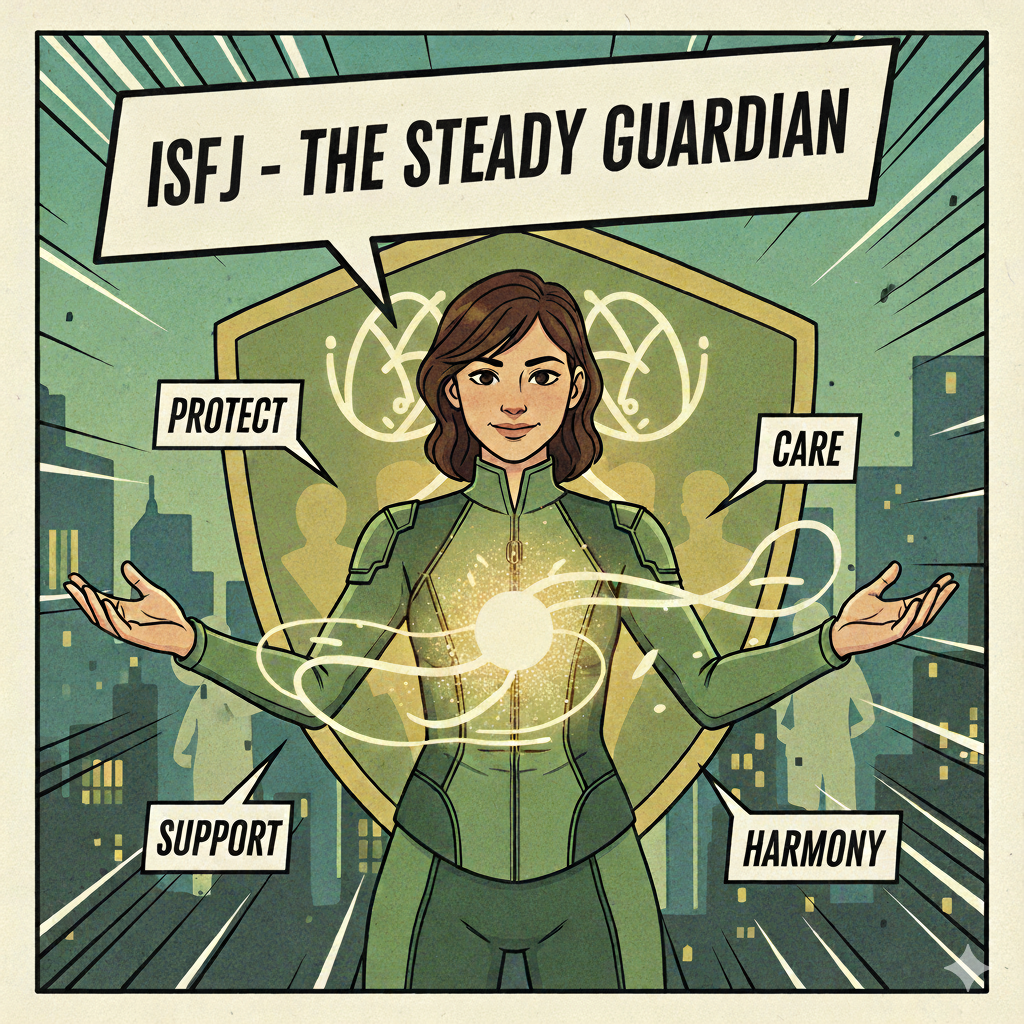
ISFJ – The Steady Guardian
An ISFJ is one of the sixteen Myers-Briggs personality types, described by the preferences Introverted, Sensing, Feeling and Judging. ISFJs are the people who notice what others need before it is asked for, remember the details that matter to individuals, and hold groups together through steady practical care. In short: ISFJs notice what people actually need, remember the specifics, and carry a great deal of work that nobody sees. Elsewhere you may see this type called the Protector or the Defender.
One framing note before the description. The usual write-up of this type slides quickly into praise for selflessness, which is both flattering and unhelpful. What follows tries to name the costs of that pattern as plainly as its strengths, because the costs are where the useful part is.
What the four letters mean for an ISFJ
- Introverted (I): ISFJs recharge privately, even though much of their attention is spent on other people. A day of caring for others is satisfying and still leaves them needing quiet.
- Sensing (S): Their attention runs on specifics — who said what, who looked tired, what was promised. Memory for personal detail is often extraordinary.
- Feeling (F): Decisions are weighed by their effect on real people rather than by abstract principle. An ISFJ will bend a rule for a person far sooner than they will bend a person to a rule.
- Judging (J): They want commitments settled and kept. Uncertainty about what is expected of them is uniquely uncomfortable.
How ISFJs think
The ordered habits for an ISFJ run: introverted Sensing, extraverted Feeling, introverted Thinking, extraverted Intuition.
Introverted Sensing leads, giving ISFJs a detailed personal record of how things have been — including how people have been. This is why an ISFJ notices that a colleague is quieter than usual, and why they can tell you what someone ordered for lunch two years ago.
Extraverted Feeling supports it, tuning them to the emotional state of the group and prompting them to act on it. Together these produce the type's signature move: a specific, well-timed, practical kindness that nobody had to request.
Introverted Thinking sits underneath and gives ISFJs a private analytical streak that surprises people who have filed them under "nice". Extraverted Intuition is least developed, so speculative, open-ended change is the hardest terrain for this type.
Strengths of the ISFJ
- Attention that lands on individuals. ISFJs see the specific person rather than the average person, and adjust accordingly.
- Reliability under real conditions. They keep going when the work is unglamorous, repetitive and unwitnessed — which is most of the work that actually holds an organisation up.
- Practical empathy. ISFJ care arrives as action: the meal, the lift, the covered shift, the form already filled in.
- Retention of what matters. Names, preferences, anniversaries, the thing you mentioned once in passing. This is not effort for them; it is how they encode the world.
- Quiet stabilising influence. Groups containing an ISFJ tend to have lower background friction, usually because the ISFJ has absorbed some of it.
Where ISFJs get stuck
- Difficulty saying no. A request from someone they like is hard to refuse, so commitments accumulate until the ISFJ is overextended and resentful — a state they will then feel guilty about.
- Conflict avoidance that stores conflict up. Small grievances go unmentioned until they arrive together, which is confusing for everyone including the ISFJ.
- Under-claiming credit. Work that is invisible by nature stays invisible when its author will not point at it.
- Change treated as loss. Because the past is vivid, replacing something that worked feels like discarding it, even when the replacement is better.
- Self-worth attached to being needed. Useful in moderation, corrosive when it becomes the only source.
ISFJs at work
ISFJs do well where care and accuracy both matter and where the beneficiary is a person rather than a metric: healthcare, education, human resources, administration, client service, veterinary work, librarianship, social work, quality-sensitive support roles. They also quietly run a great many teams as the person who actually knows how everything works.
What tends to help an ISFJ perform:
- Clear expectations and stable priorities.
- Explicit acknowledgement, given specifically rather than generically.
- Permission to decline work without it being treated as a problem.
- Advance notice of change, with reasoning attached.
What tends to drain them: aggressive conflict, being publicly corrected, constant reorganisation, and roles where helping people is technically not their job but happens anyway.
The classic ISFJ career risk is becoming indispensable in an unrewarded way — absorbing the coordination, the emotional labour and the institutional memory of a team while being formally responsible for none of it.
ISFJs in relationships
ISFJs are devoted partners and friends, and their loyalty is unusually durable. They express affection through attentiveness and service, and they keep a detailed mental record of what the other person likes, fears and needs.
The main risk is asymmetry. ISFJs frequently give considerably more than they ask for, and then feel unseen — while never actually stating the need, because stating it feels like a demand. Relationships with ISFJs work far better when the other person makes a habit of asking directly and specifically what the ISFJ wants, and treats the answer as important.
ISFJs also take criticism of their care personally, because the care is personal. Feedback about a task is heard as feedback about the relationship unless it is separated clearly.
ISFJs under stress
Under pressure, an ISFJ over-functions: doing more, checking more, managing everyone else's comfort while their own conditions deteriorate. Fatigue then shows up as uncharacteristic irritability and a sense of being taken for granted.
Pushed further, the usually-hidden possibility-generating side surfaces destructively, and an ordinarily grounded person begins imagining worst-case outcomes and reading catastrophe into ordinary events.
Recovery generally requires someone else to reduce the load rather than the ISFJ deciding to. Rest, a genuinely lowered set of obligations, and being cared for rather than caring are what work.
Common misconceptions about ISFJs
- "ISFJs are pushovers." They concede on preferences and become immovable on values. Threaten someone under their protection and the pleasantness disappears immediately.
- "ISFJs lack ambition." Many are highly ambitious about mastery and standards; they are simply not interested in the self-promotion that usually accompanies visible ambition.
- "ISFJs are only sentimental." There is a real analytical capability under the warmth, generally kept private.
- "ISFJs never get angry." They do. It arrives late, all at once, and usually shocks people who mistook patience for indifference.
How ISFJ differs from similar types
- ISFJ vs ISTJ: Both are careful, dependable and anchored in experience. The ISTJ optimises for correctness and consistent standards; the ISFJ optimises for people and relationships. Given an unfair rule, the ISTJ argues that it is inconsistent, the ISFJ that it is hurting someone.
- ISFJ vs ESFJ: The same warmth pointed differently. ESFJs organise groups openly and are energised by social coordination; ISFJs prefer to support individually and are depleted by sustained group attention.
- ISFJ vs INFJ: Both are private, caring and conscientious, and they are often confused. The ISFJ works from concrete remembered detail and present needs; the INFJ works from pattern and future implication. ISFJs are more grounded and more practically useful day to day; INFJs are more symbolic and more future-directed.
- ISFJ vs ISFP: Both are gentle and values-driven. The ISFP resists structure and schedules; the ISFJ wants them settled. ISFPs need freedom, ISFJs need certainty.
How this result was arrived at
A four-letter result is only as good as the instrument behind it, so here is that instrument.
Our test asks eight questions, two per dimension, scored positionally: the four preferences are decided independently of one another, and no combination is treated as more desirable than another in the scoring.
For ISFJ, the dimension that most often lands close is J/P. Attentiveness to other people's needs produces a lot of planning behaviour, and two questions cannot always tell a genuine preference for closure apart from planning done on someone else's behalf. Where that felt close, the ISFP description is the one to read next.
Eight questions pointing at ISFJ is a useful starting hypothesis. It is not a boundary, and it is not a diagnosis.
Is this actually you?
If large parts of this fit and some clearly do not, that is the expected outcome rather than a contradiction: four letters describe tendencies, not a whole person, and the parts that miss are information.
If it feels close but not exact, answering the questions yourself is a faster check than reasoning about the description, and the result costs nothing to discard.