
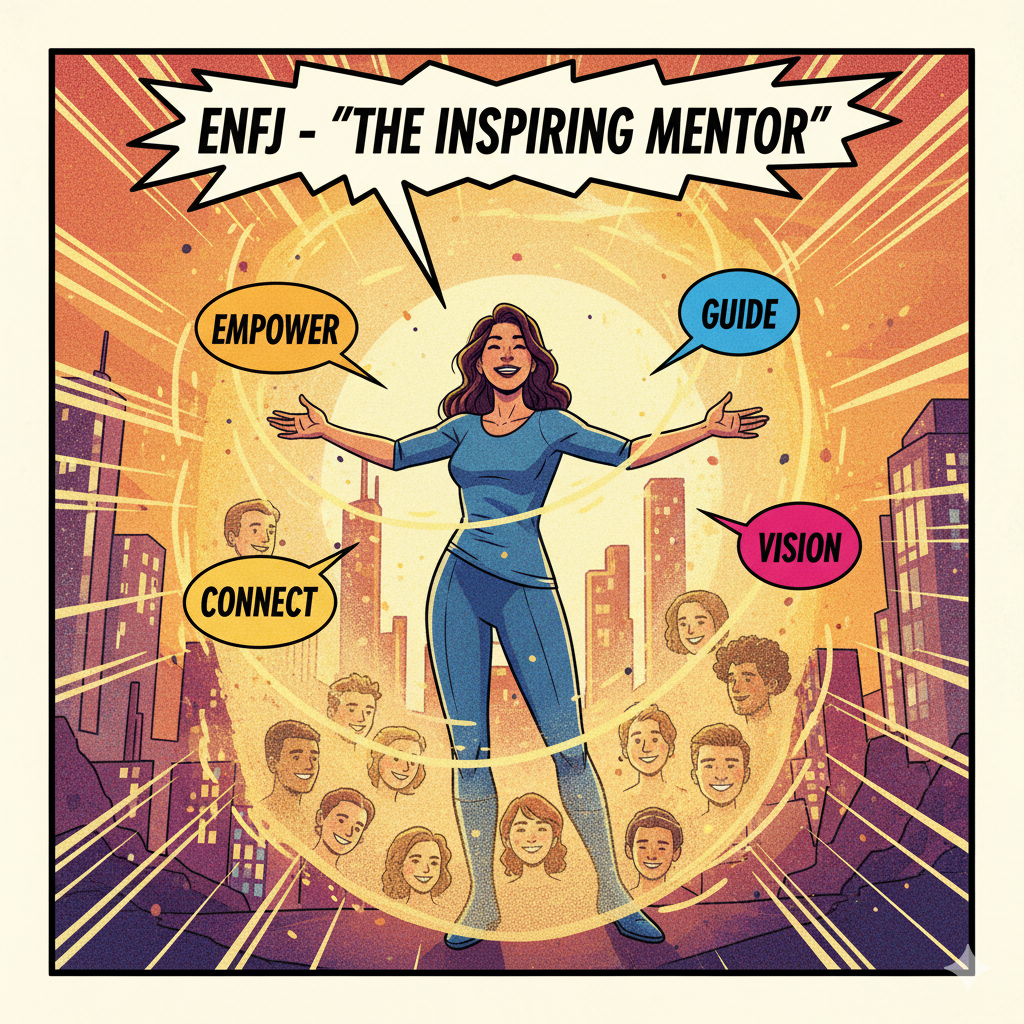
ENFJ – The Inspiring Mentor
An ENFJ is one of the sixteen Myers-Briggs personality types, described by the preferences Extraverted, Intuitive, Feeling and Judging. ENFJs see what people could become and organise things so that it happens, often taking responsibility for a group's direction without being formally asked. In short: the ENFJ default is to invest in other people's potential faster than they invest in their own, which is both the gift and the recurring bill. Elsewhere you may see this type called the Teacher or the Protagonist.
One framing note before the description. It is easy to write about this type as though seeing potential in people were uncomplicated. It is not: a picture of who someone could become is also a standard they did not agree to, and the sections below treat that as part of the pattern rather than an aside.
What the four letters mean for an ENFJ
- Extraverted (E): ENFJs are energised by people and think out loud. Extended solitude is restorative in small doses and flattening in large ones.
- Intuitive (N): Attention runs to potential and trajectory — where a person or a group is heading, and what they could be.
- Feeling (F): Decisions are weighed by human impact, and harmony is treated as a genuine objective rather than a preference.
- Judging (J): They want direction settled and progress visible. Drift is uncomfortable.
How ENFJs think
The ordered habits for an ENFJ run: extraverted Feeling, introverted Intuition, extraverted Sensing, introverted Thinking.
Extraverted Feeling leads, tuning them continuously to the emotional state of the people around them and prompting action to improve it. ENFJs read rooms accurately and adjust in real time, which is why they can hold together groups that would otherwise fragment.
Introverted Intuition supports it with a convergent sense of where things are going and what someone is capable of. Together these produce the type's signature capability: articulating a future that other people then want to work toward.
Extraverted Sensing keeps them reasonably grounded in the present. Introverted Thinking is least developed, which is why ENFJs can struggle to detach from the human dimension and evaluate something purely on its merits.
Strengths of the ENFJ
- Developing people. ENFJs see potential accurately and invest in it, and many careers exist because an ENFJ said something at the right moment.
- Articulating direction. They can express a shared purpose in a way that makes it feel achievable.
- Emotional read of a group. Problems are noticed early, while they are still small.
- Follow-through. Unlike some idealists, ENFJs organise, commit and finish.
- Willingness to take responsibility for others. They step into the gap when a group needs someone to hold it.
Where ENFJs get stuck
- Over-responsibility. Taking ownership of outcomes that belong to other people is exhausting and, past a point, disrespectful of their autonomy.
- Self-neglect. Own needs are deferred behind everyone else's until something breaks.
- Approval sensitivity. Being disliked is genuinely costly, which can soften decisions that needed to be firm.
- Difficulty with detachment. Purely logical trade-offs involving people are hard to make cleanly.
- Conflict avoided or over-managed. ENFJs may work around a problem person for a long time rather than confront the issue directly.
ENFJs at work
ENFJs need work involving people and purpose. Common fits: teaching and academic leadership, coaching and counselling, human resources and organisational development, non-profit leadership, healthcare leadership, communications, sales leadership, and general management in mission-led organisations.
What tends to help an ENFJ perform:
- Purpose they believe in, and permission to talk about it.
- Responsibility for people's development, not just their output.
- Colleagues who communicate openly.
- Boundaries that someone else helps enforce.
What tends to drain them: cynical environments, sustained interpersonal hostility, isolated technical work, and being required to implement decisions they consider harmful to people.
The recurring career risk is burnout by absorption: ENFJs take on the emotional load of a team, keep performing, and give little external signal of the cost until it is significant.
ENFJs in relationships
ENFJs are attentive, committed partners who invest heavily and take the relationship's health as a personal responsibility. They are good at drawing people out and at making a partner feel understood and encouraged.
Two difficulties recur. The first is over-functioning — managing a partner's growth, feelings or life logistics to a degree that becomes parental rather than mutual. The second is unstated need: ENFJs often give a great deal while finding it hard to say plainly what they want, then feel unseen.
Relationships work better when the ENFJ is asked directly and regularly what they need, and when they resist the urge to fix what has not been handed to them.
ENFJs under stress
Under moderate stress ENFJs increase caretaking: doing more for others, managing harder, and ignoring their own depletion.
Under severe stress the least-developed analytical side takes over and a normally warm, encouraging person becomes uncharacteristically cold and hypercritical — withdrawing, picking apart other people's logic, or turning a harsh analytical eye on themselves. It is markedly unlike them.
Recovery requires an actual reduction in obligations, rest, physical activity, and someone willing to look after them for a change.
Common misconceptions about ENFJs
- "ENFJs are manipulative." They are persuasive and socially perceptive. Those capacities can be misused by anyone; in most ENFJs they are aimed at the other person's benefit.
- "ENFJs are always positive." The encouragement is real and frequently sits on top of private exhaustion or doubt.
- "ENFJs are pushovers." They accommodate on preferences and hold firm on values, and they will confront when someone is being harmed.
- "ENFJs are only feelers." Many are highly strategic; the strategy is simply pointed at people rather than at systems.
How ENFJ differs from similar types
- ENFJ vs INFJ: The same values, differently sourced. ENFJs draw energy from engaging and leading groups; INFJs need to withdraw to think and prefer influence at close range.
- ENFJ vs ENFP: Both are people-focused and inspiring. The ENFJ organises, commits and drives toward a defined outcome; the ENFP keeps options open and resists being scheduled.
- ENFJ vs ESFJ: Both are warm, organised and people-focused. The ENFJ works from a longer-range vision of what people could become; the ESFJ from concrete present needs and precedent.
- ENFJ vs ENTJ: Both lead and organise naturally. The ENTJ optimises the system and accepts human cost as a trade-off; the ENFJ optimises for people and treats the system as the instrument.
How this result was arrived at
Before making much of a four-letter result, it helps to know how it was produced.
Eight questions, two per dimension, scored positionally — each preference is settled on its own, with no combination treated as more desirable than another.
For ENFJ the dimension that most often lands close is S/N. Attending to what a person could become and attending to what they need right now are different orientations that frequently appear together in the same helpful behaviour, and two questions do not reliably separate them. Where the N felt marginal, the ESFJ description is worth reading beside this one.
An ENFJ result here means eight questions pointed that way — a hypothesis about your defaults rather than a conclusion about you.
Is this actually you?
Read this as a description of where your attention goes by default, not as a summary of who you are, and treat the parts that do not fit as worth thinking about rather than as errors.
If the picture feels close but not exact, answering the questions yourself will settle it faster than reading further.