
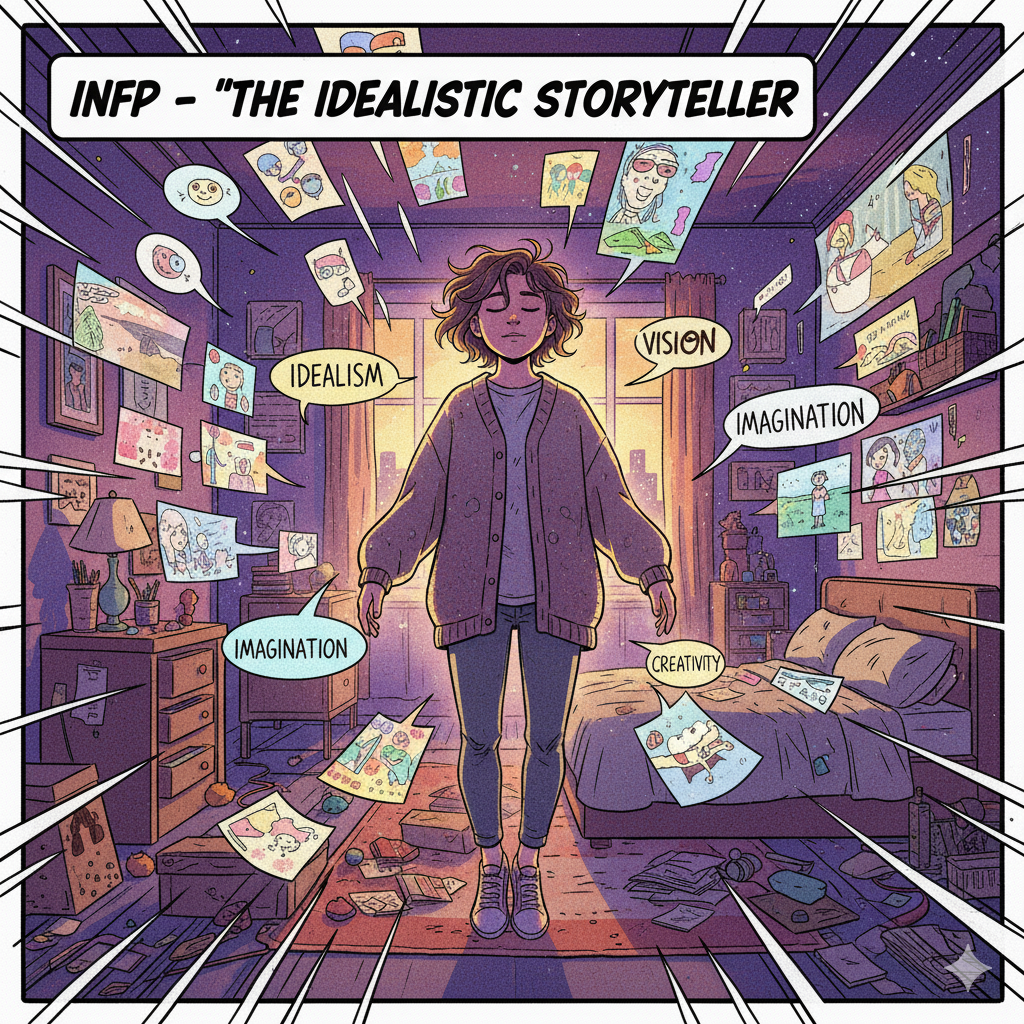
INFP – The Idealistic Storyteller
An INFP is one of the sixteen Myers-Briggs personality types, described by the preferences Introverted, Intuitive, Feeling and Perceiving. INFPs measure the world against a private standard of what it ought to be, and they are usually more certain about their values than about their plans. In short: INFPs run decisions through a private set of values, and will hold a position for years without needing anyone to agree. Elsewhere you may see this type called the Healer or the Mediator.
One framing note before the description. INFP is the most common result in our own data, which sits oddly beside the amount of writing describing it as rare and misunderstood. What follows tries to describe the pattern rather than compliment it.
What the four letters mean for an INFP
- Introverted (I): INFPs need real solitude to think. They can be warm and expressive in company and still return home needing hours alone.
- Intuitive (N): Attention runs to meaning, possibility and what something could become rather than to its present state.
- Feeling (F): Decisions are checked against a deeply held internal sense of what is right. The standard is personal rather than social, which is why an INFP can defy consensus without much difficulty.
- Perceiving (P): They keep questions open, sometimes long past the point where a decision would help.
How INFPs think
The ordered habits for an INFP run: introverted Feeling, extraverted Intuition, introverted Sensing, extraverted Thinking.
Introverted Feeling leads, and it works as a continuously consulted internal register: is this honest, does this match what I actually believe, can I live with it. INFPs often cannot argue for these conclusions in the moment and remain completely certain of them.
Extraverted Intuition supports it, generating possibilities outward — connections, alternatives, what-ifs, characters and stories. The combination is what makes so many INFPs writers, and also what makes decisions hard: every option is visible at once, and each is evaluated against an ideal.
Introverted Sensing underneath gives them a vivid, sentimental relationship with their own past. Extraverted Thinking — external structure, logistics, metrics — is least developed, and is the usual location of INFP difficulty: deadlines, admin, money and the mechanics of turning an intention into a shipped thing.
Strengths of the INFP
- Moral clarity. INFPs know what they believe and are unusually resistant to being talked out of it by social pressure.
- Depth of empathy. They understand what an experience is like from the inside, which is why their writing and counsel can land so precisely.
- Imaginative range. Ideas connect freely and productively; INFPs are frequently the origin of an idea a more structured type later executes.
- Acceptance of individuals. People are met as they are, with real curiosity and little moralising, which makes INFPs safe to confide in.
- Persistence on what matters. An INFP with a cause will sustain effort for years without external reward.
Where INFPs get stuck
- Ideal versus shipped. The imagined version is better than anything achievable, which can make finishing feel like a betrayal of the idea.
- Decisions left open. With every possibility visible and each measured against an ideal, choosing feels like loss, so choices get deferred until circumstances make them.
- Criticism taken as identity. Because the work carries the values, feedback on the work is felt personally, even when it is offered carefully.
- Practical neglect. Money, admin, scheduling and self-promotion get postponed, sometimes at real cost.
- Withdrawal in conflict. Retreat is the default, and unresolved grievances accumulate quietly rather than being aired.
INFPs at work
INFPs need to believe in the work; without belief, capability does not convert into output. Common fits: writing and editing, counselling and therapy, teaching, the arts, non-profit and advocacy work, user research, librarianship, and mission-led product or design roles.
What tends to help an INFP perform:
- Purpose they actually believe in, stated honestly.
- Autonomy over how and when.
- Deep uninterrupted time rather than fragmented availability.
- Feedback framed around the work with the person's intent acknowledged.
What tends to drain them: cynical environments, aggressive competition, heavy bureaucracy, rigid micromanagement, and being asked to advocate for something they consider dishonest.
The characteristic career problem is capability outrunning structure. INFPs frequently need an external commitment device — a collaborator, a deadline with a person attached, a public promise — to convert intention into finished work.
INFPs in relationships
INFPs are devoted, idealistic partners who take relationships seriously and are slow to enter them. They offer unusual acceptance and are genuinely interested in who the other person actually is.
The recurring difficulty is idealisation: forming a vivid picture of a partner, or of the relationship, and then experiencing the ordinary reality as a disappointment that feels like betrayal. The second is conflict avoidance — INFPs postpone difficult conversations, absorb grievances, and can arrive at a decision the other person never saw coming.
Relationships work considerably better when the INFP names small problems early, while they are still small and still discussable.
INFPs under stress
Under moderate stress INFPs withdraw, ruminate and become self-critical, replaying interactions and measuring themselves against the ideal.
Under severe stress the least-developed organising side takes over and a normally gentle person becomes uncharacteristically harsh — blunt, critical, fixated on efficiency or on being objectively right, often aimed at themselves. It is markedly unlike them and usually followed by remorse.
Recovery requires reduced input, sleep, creative expression without an audience, physical movement, and one person who listens without trying to fix.
Common misconceptions about INFPs
- "INFPs are naive." Many are acutely aware of how the world falls short; the idealism persists in spite of that awareness rather than because of ignorance.
- "INFPs are too sensitive." Sensitivity is the same faculty that produces the empathy and the writing. It is a cost of the capability, not a defect.
- "INFPs are unproductive." Motivated by something they believe in, INFPs work relentlessly. The variance is in belief, not in capacity.
- "INFPs avoid all conflict." They avoid petty conflict and will confront directly when a core value is at stake.
How INFP differs from similar types
- INFP vs INFJ: The pair most often confused. INFPs generate possibilities outward and hold values inward, which makes them exploratory, open-ended and slower to decide. INFJs converge inward on a single conclusion and express values outward, which makes them more decisive, more organised and more attentive to group harmony.
- INFP vs ISFP: Both are private and values-led. The INFP lives in possibility and meaning and tends to express through language; the ISFP lives in the present and the physical and tends to express through making.
- INFP vs ENFP: The same idealism and idea-generation at different volumes. ENFPs think out loud, need people and start many things; INFPs think privately, need solitude and go deeper on fewer.
- INFP vs INTP: Both are private, open-ended and independent. The INTP asks whether an idea is logically coherent; the INFP asks whether it is right. They frequently reach the same conclusion by incompatible routes.
How this result was arrived at
Four letters are worth what the instrument behind them is worth, so it is worth saying how this one works.
Our test asks eight questions, two per dimension, scored positionally — the four preferences are settled independently, and no result is weighted as more desirable than another.
For INFP, the dimension that most often comes out close is J/P. A strong internal set of values produces a lot of quiet consistency, and consistency can read as a preference for closure when it is really conviction. Where the P felt marginal, the INFJ description is the one to read next.
So an INFP result here means eight questions pointed that way. That is a starting point for self-description, not a boundary that has been established.
Is this actually you?
Read this as a description of defaults rather than an identity to defend — the type attracts a great deal of flattering writing, and flattery is not observation.
If it feels close but not exact, answering the questions yourself is a faster check than reasoning about the description, and the result costs nothing to discard.